Measuring AI-Assisted Engineering: The Metrics That Matter (and the Ones That Lie)
License counts and anecdotal speedups do not prove AI adoption is working. An executive framework for baselines, outcome metrics, review burden, platform-fit signals, and governance—so leaders know whether AI is changing economics or just accelerating the wrong architecture.
Measuring AI-Assisted Engineering: The Metrics That Matter (and the Ones That Lie)
AI adoption creates a strange reporting problem for technology leaders.
The anecdotes are compelling. One engineer ships in a day what used to take a week. A team clears a backlog of small bugs. A prototype reaches demo quality faster than anyone expected. License dashboards look healthy. Usage charts go up and to the right.
At the same time, senior engineers may be quietly absorbing more review burden. Architecture decisions may be getting made faster than they are being understood. Teams may be using AI to push familiar stacks beyond their natural fit instead of stepping back and asking whether the platform choice is still right.
That is the measurement gap. AI adoption fails when leaders track access instead of economics, activity instead of outcomes, and local velocity instead of direction. The question is not whether people are using AI. The question is whether AI is changing the economics of engineering without lowering quality, security, reliability, or architectural judgment.
I have seen AI help build serious systems quickly when it is directed by domain expertise, structured workflows, and quality oversight—the pattern behind building enterprise software at AI speed. I have also seen AI make the wrong path easier to continue. Measurement is how leaders tell the difference.
The Measurement Trap
The easiest AI metrics to collect are often the least useful.
License adoption tells you who has access. Prompt volume tells you who is active. AI-generated lines of code tell you how much output was produced. None of those measures tell you whether the organization is better.
These are the vanity metrics I would be careful with:
- License or seat adoption. Access is not capability. A team can have 90% license activation and still have no repeatable AI workflows.
- AI-generated lines of code. Volume is not value. This can reward bloat, duplication, and changes that create review drag.
- Prompts per developer per week. Activity is not throughput. A struggling team may prompt more because the workflow is unclear.
- Tool satisfaction from early adopters. Useful signal, but biased toward the people most likely to self-select into the experiment.
- Pilot success stories. Anecdotes are valuable for learning, but they are not operating metrics until the workflow is reproducible by more than one person.
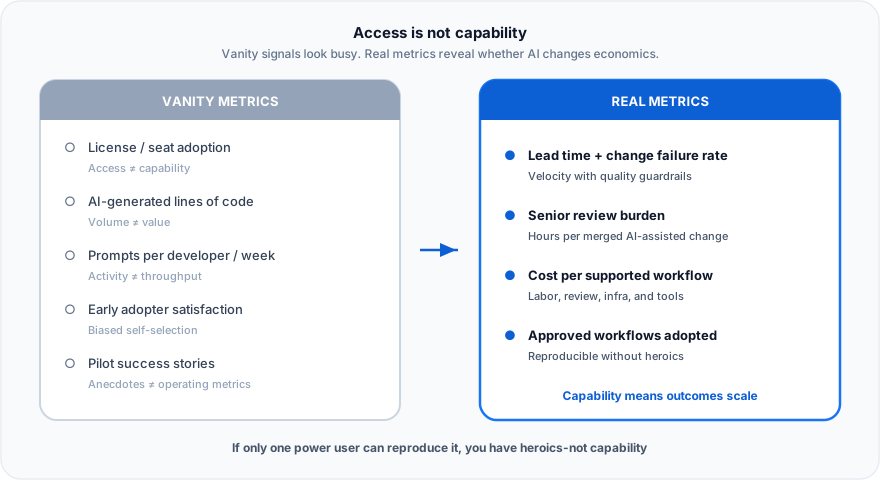
This is the same distinction I made in Agent Sprawl Is the New Shadow IT: do not measure AI adoption by license count. Tool access is not capability. Capability means a new team member can follow an approved workflow and get a trustworthy result without relying on one power user.
The executive test is simple: if your best AI-enabled engineer, platform lead, or product operator left tomorrow, could the rest of the organization reproduce the workflow?
If the answer is no, you have individual heroics with better tools. You do not yet have AI capability.
What Good Measurement Actually Answers
Good AI measurement answers executive questions, not tool questions.
The monthly review should be able to answer:
- Are we shipping faster without breaking things? Measure velocity and quality together, never separately.
- Are senior engineers gaining leverage or drowning in review? AI can increase output while moving the bottleneck to reviewers.
- Is AI creating risk we cannot see? Track security, data exposure, policy violations, and incident contribution.
- Are the economics improving? Measure cost per unit of work, not just tool spend.
- Are we scaling the right thing? Watch for teams adding infrastructure band-aids when the platform choice is the problem.
- Are we protecting sunk cost or preserving real value? Long-lived codebases may still matter, but AI changes the economics of replatforming.
That last pair is where many measurement programs are too shallow. They can tell you whether work is moving faster, but not whether the team is moving in the right direction.
This is also where fractional technical leadership can create leverage: defining the metrics, governance, and review cadence before AI-assisted work scales beyond the teams that understand it best.
AI can accelerate a bad architecture. It can also make a disciplined replatform faster than another year of patching a system that was never designed for the cloud. Measurement has to distinguish between those cases.
Platform Decisions: Two Traps AI Makes Faster
The hard question is no longer, “Can AI write the code?”
It can write code. Good teams can use it to produce quality work quickly. The harder question is whether the team is using AI to go faster in the right direction.
Two patterns show up often. From a distance, they look similar: more infrastructure, more complexity, more spend, more urgency. But they require opposite responses.
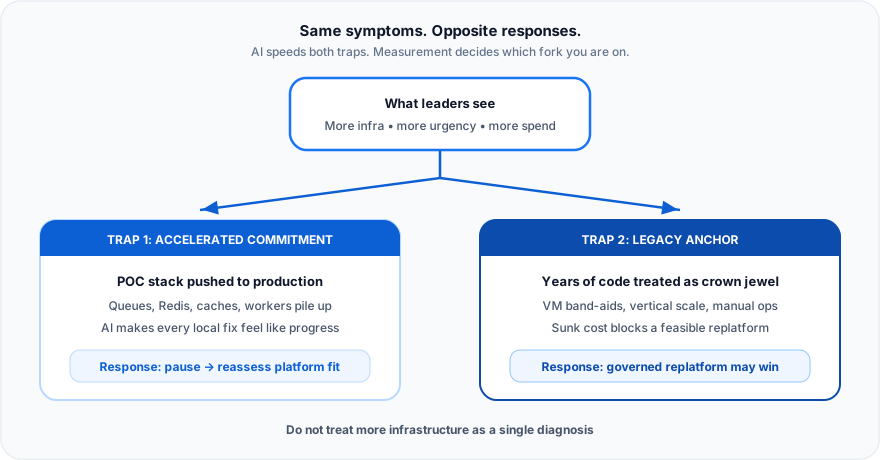
Trap 1: Accelerated Commitment
The first pattern is accelerated commitment. A team chooses a familiar language or framework for a proof of concept, proves the idea quickly, then uses AI to push that POC toward production. Because AI makes every local fix easier to generate, the team keeps moving instead of pausing to ask whether the original platform choice still fits the scale problem.
I have seen this with a flight scheduling system that started as a Python/FastAPI proof of concept. That was a reasonable place to begin: familiar stack, fast iteration, quick demo value. Then AI-assisted development helped the team move quickly toward production and early scale. Leadership read that speed as validation.
When throughput and latency became real constraints, the answer became more implementation. Add queues. Add Redis. Add caching. Add async patterns. Add workers. Each addition looked like progress because AI could help generate the code, wire the pieces together, and explain the pattern well enough to keep the team moving.
But nobody stopped to ask the more important question: was the platform choice itself the bottleneck?
The result was predictable. Complexity grew faster than capacity. Infrastructure cost rose. The system became harder to reason about. The team was not solving the scheduling problem anymore; it was managing the consequences of pushing the wrong platform too far.
This is one of the most important lessons of AI-assisted engineering: AI amplifies both good and bad practices. I have written before that fundamentals still matter in AI Workflow Integration with Cursor and Claude. In this case, AI amplified architectural inertia.
The metrics that would have surfaced the problem earlier are not exotic:
- Scale gate before POC-to-production. Define load, latency, and reliability targets before declaring production readiness.
- Complexity growth rate. Track infrastructure components added versus throughput gained. If queues, caches, and workers grow faster than capacity, suspect platform fit.
- Cost per schedule update or transaction. Unit economics should improve after optimization. If they stay flat or rise, the “fix” may be adding cost without solving the problem.
- Architecture review checkpoint. A second async layer should trigger a deliberate platform review, not another sprint of implementation.
- Step-back trigger. When p99 latency, cloud spend, or operational toil crosses a threshold, pause feature work and evaluate platform fit.
Velocity looked good while the team was building the wrong thing faster. Measurement has to include direction, not just speed.
Trap 2: Legacy Anchor
The second pattern points the other way.
Some teams have been on VM-hosted instances for years. They moved to hosted infrastructure, but never really embraced cloud-native patterns. They scale vertically. They add scripts. They patch deployment flows. They keep manual operations alive because everyone understands the pain and nobody wants to risk the rewrite.
The codebase took years to build, so leadership treats it as the crown jewel. Replatforming sounds expensive, risky, and slow.
That assumption needs to be challenged in an AI-assisted world.
AI does not make rewrites magically safe. It does not remove the need for architecture, quality assurance, deployment discipline, or operational ownership. But it does change the economics. A disciplined team that knows what it is building can produce quality code much faster than before, especially when the existing system has already taught the domain model, workflows, edge cases, and operational requirements.
What used to be valued—the codebase accumulated over years—is no longer the full value. The durable assets are different:
- Clarity of intent. Specs, domain rules, acceptance criteria, and a precise understanding of what the system must do.
- Architectural due diligence. Platform-fit decisions, load targets, integration boundaries, and review gates before scale.
- QA and deployment discipline. Tests, staged rollout, rollback paths, and production validation.
- Operational ownership. Observability, cost attribution, runbooks, and incident response built into the path.
In that environment, a governed replatform or parallel build can be faster than another year of VM band-aids. That does not mean a reckless rewrite. It means treating the decision the same way you would treat a serious platform migration: business case first, zero-downtime requirements, phased cutover, rollback planning, and executive alignment—the discipline behind large-scale platform migration.
It also means applying the same diligence lens I described in Technical Due Diligence for Acquirers and Boards. AI-assisted replatforming needs architecture review, platform validation, QA gates, and deployment controls. Without those, AI will recreate the same mess faster.
The metrics that distinguish replatform from band-aid are practical:
- Band-aid cost trajectory. VM count, manual ops hours, incident frequency, deployment friction, and support load over twelve months.
- Replatform comparison. Cost and time for a governed parallel build versus the next twenty-four months of patches, including engineering labor.
- Governance readiness. Architecture review, QA gates, deployment pipelines, rollback, and observability in place before AI-accelerated work begins.
- Cutover risk. Same zero-downtime and rollback criteria you would use for any serious migration.
- Post-cutover unit economics. Cost per transaction, cost per user, or cost per workflow after replatform versus the VM baseline.
Do not let “years of code” block a replatform that AI now makes feasible. Also do not replatform without the discipline that keeps AI output from drifting. Measurement tells you which mistake you are about to make.
The Metrics That Matter
A useful AI dashboard is not large. It is disciplined. Each metric should have a baseline, an owner, a review cadence, and a decision attached to it.
Velocity with Guardrails
Measure lead time for change by workflow type: bugfix, small feature, refactor, infrastructure change, incident remediation. Track cycle time from approved scope to production, not just code completion.
Red flags:
- Lead time improves while change failure rate rises.
- AI-assisted work piles up in review because the output is not trusted.
- Velocity rises while infrastructure complexity and unit cost rise with it.
Quality and Review Burden
AI can make teams look faster while shifting cost onto senior engineers. That is not leverage. That is a hidden tax.
Measure:
- Change failure rate
- Deployment rollback rate
- Escaped defects tied to recent changes
- Senior review hours per merged change
- Rework rate after AI-assisted pull requests
The review burden metric matters because many organizations mistake output for throughput. If junior developers generate more changes but senior engineers spend twice as long cleaning them up, the system has not improved.
Security and Governance
AI-assisted work needs visible boundaries. Track:
- Incidents tied to AI-assisted changes
- Secrets, policy, or data boundary violations
- Use of approved workflows versus shadow usage
- Human approval coverage for high-risk changes
- Auditability of prompts, context, tool calls, and generated changes where appropriate
This is not about slowing teams down. It is about making the safe path fast enough that teams want to use it.
Cost and Unit Economics
Tool spend is only one part of cost. The real question is cost per supported workflow.
Measure:
- API and license cost per workflow
- Engineer time saved or added
- Review time added or reduced
- Infrastructure cost created by AI-assisted changes
- Cost per feature, incident resolved, or transaction when the workflow is repeatable
An API bill can look reasonable while review labor doubles. A rewrite can look expensive while VM band-aids are quietly consuming more over twenty-four months. AI measurement has to include the whole system.
Capability Maturity
The strategic goal is not personal productivity. It is organizational capability.
Measure:
- Adoption of approved workflows, not just approved tools
- Time for a new team member to produce acceptable output with a supported workflow
- Workflow template reuse rate
- Number of workflows with documented context, validation, and owners
This connects directly to the point in LLMs Are Becoming a Commodity: durable advantage comes from workflow, context, validation, and operating discipline—not vendor selection.
Developer Experience
Qualitative signal still matters, but it should be structured.
Ask quarterly:
- Where does AI save meaningful time?
- Where does it create review burden?
- Which outputs do engineers trust?
- Which workflows should be standardized?
- Where are people avoiding the approved path because it is too slow?
Use this as signal, not proof. Pair it with the hard metrics above.
Establish Baselines Before You Claim Victory
Many organizations roll out tools broadly and then try to prove value after the fact. By then, the baseline is gone.
Start smaller:
- Pick two or three high-volume workflows: small bugfixes, test generation, incident triage, infrastructure drift analysis, or documentation refresh.
- Measure the current state for thirty days without changing the process.
- Introduce AI assistance on one team with a defined workflow, validation steps, and clear ownership.
- Compare at sixty and ninety days using the same definitions.
- Decide whether to expand, modify, or retire the workflow.
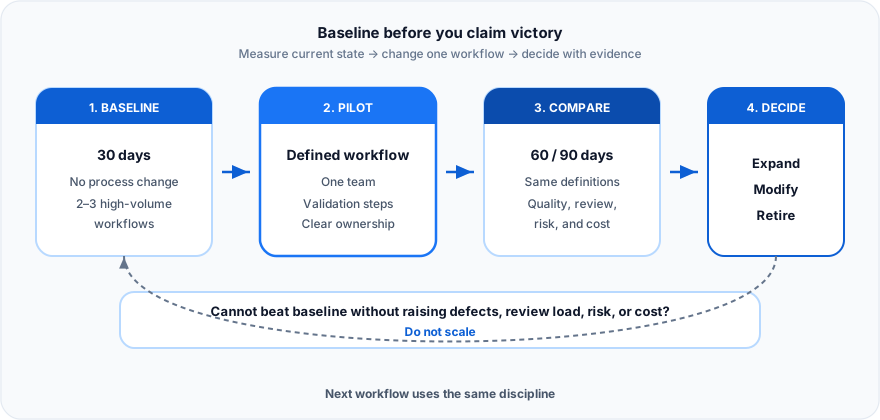
The important part is not the exact duration. The important part is discipline. If a workflow cannot beat its baseline without increasing defects, review load, risk, or cost, it should not scale.
This is the same measurement habit executives need for platform engineering ROI: define the outcome, measure the current state, change the operating model, then track whether the economics actually improved. The tooling is new. The leadership discipline is not.
The Executive Dashboard
An executive AI dashboard should fit on one page.
It should show trends, not tool trivia:
- North star: Lead time plus change failure rate over ninety days
- Review burden: Senior review hours per merged AI-assisted change
- Risk: AI-related incidents, policy violations, and severity
- Economics: Cost per supported workflow for the top three workflows
- Maturity: Approved workflow adoption and new-user time-to-competence
- Platform fit: Complexity growth versus throughput or unit-cost improvement
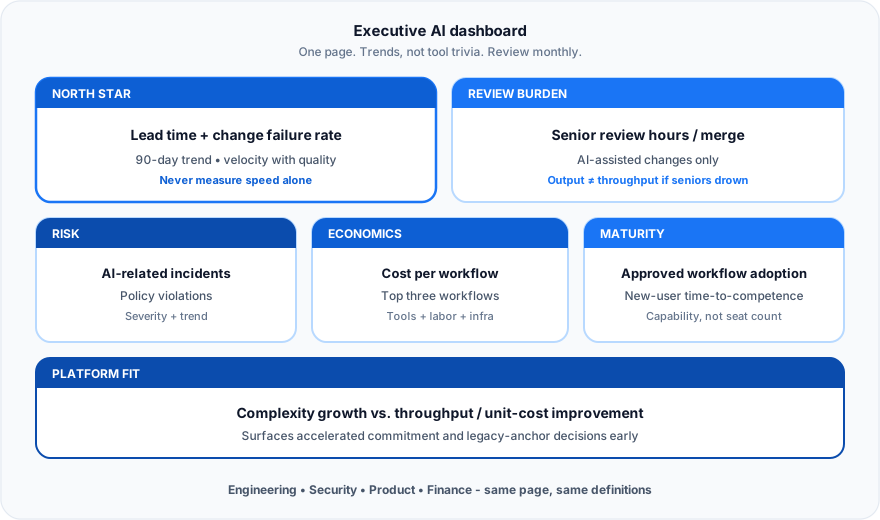
Review it monthly with engineering, security, product, and finance represented. Keep the conversation at the level of workflows and outcomes. Do not let it become a weekly debate over which model, IDE, or assistant had the best demo.
Quarterly, review the workflow portfolio:
- Which workflows should expand?
- Which need better guardrails?
- Which are producing too much review burden?
- Which should be retired?
- Which architecture or platform decisions need a step-back review?
That last question is where the dashboard becomes more than productivity reporting. It becomes a steering mechanism.
Common Failure Modes
The failures repeat:
- Speed without standards. Velocity rises, but escaped defects and review time rise with it.
- Governance after the fact. Shadow usage grows before approved workflows exist.
- Hero dependency. One team’s numbers look excellent, but nobody else can reproduce the workflow.
- Cost myopia. Leaders track API bills but ignore review labor, infrastructure complexity, and operational toil.
- Pilot forever. Anecdotes keep improving, but approved workflow adoption stays flat.
- Accelerated commitment. A POC stack gets pushed to production with AI, then queues, Redis, and caches pile up when platform fit was the real issue.
- Legacy anchor. VM-era band-aids continue because the codebase “took years,” even when measurement shows a governed replatform would be faster and cheaper.
Each failure mode has a metric that exposes it early. The hard part is not instrumentation. The hard part is acting when the metric challenges the story leaders want to believe.
Conclusion
The organizations that win with AI will not be the ones with the most licenses, the most prompts, or the loudest adoption story. They will be the ones that measure whether AI changes the economics of engineering and whether those economics hold under quality, security, architecture, and deployment pressure.
That means faster delivery with stable change failure rates. More output without drowning senior engineers in review. Visible governance without freezing teams. Lower cost per workflow without hiding infrastructure or labor costs. Platform decisions that can distinguish between a bad POC being scaled too far and a legacy VM system that should finally be replatformed.
Codebase tenure alone is no longer the asset. Clarity, due diligence, operating discipline, and the ability to direct AI through a governed path to production are becoming the real leverage.
Enthusiasm is not evidence. Baselines are. And speed in the wrong direction is still the wrong direction—but so is clinging to sunk cost when measurement says replatform.
Scaling AI-assisted engineering and need governance, standards, and measurement that executives can trust? Connect with me on LinkedIn to discuss practical AI adoption.
Related insights
Cognitive Debt: What Teams Must Still Understand When AI Writes the Middle
Teams do not need to know every implementation detail when AI is a competent middle-layer partner. Cognitive debt is losing the durable high-level model—intent, boundaries, invariants, and failure modes—required to direct that partner and intervene when it is wrong.
Agent Sprawl Is the New Shadow IT: Why AI Adoption Needs Platform Engineering
Agentic AI is moving from pilots into production workflows, creating a new form of shadow IT. Technical leaders need platform engineering discipline to manage AI agents with governance, context standards, validation, observability, and cost control.
The Leadership-Grade Homelab: Why Tech Leaders Need Skin in the Runtime
A production-shaped lab is not a hobby rack—it is deliberate practice that keeps technical judgment calibrated when enterprise stakes are high. Why tech leaders need skin in the runtime.