Own Your Destiny: Why AI Makes Vendor Default Obsolete
There is no better time to tackle tech debt and vendor decisions. AI and open platforms are making rented SaaS and contracted code optional again—if leadership still has skin in the runtime.
There is no better time to tackle tech debt and vendor decisions.
For a decade the safe executive move was simple: rent the platform, rent the SaaS suite, and contract the hard code. Vendors owned the roadmap. Integrators owned the delivery. Leadership owned the budget meetings. Debt got deferred because the cost of owning the alternative looked higher than the cost of renewing the invoice.
That math changed. The comfort blanket is now expensive—and optional.
I provide leadership augmentation on large technical programs. I also keep owned products and a production-shaped lab on purpose. Those are deliberate practice: they hone decision skills and trench skills so judgment stays sharp when the stakes are enterprise-scale. The practice is personal. The application is not.
Three Rental Traps
Vendor dependency is not only an infrastructure problem. It shows up in three places that look different on a spreadsheet and fail the same way in practice.
1. Infra platform lock. Control plane, muscle memory, restore story, and legacy estates all sit inside one vendor’s gravity. When pricing or policy shifts, leaders scramble for an exit. Teams that never operated the runtime end-to-end cannot evaluate alternatives honestly. They can only compare decks. Hypervisor churn—VMware included—is one visible form of this debt, not the whole argument.
2. SaaS that owns your workflow. The product is convenient until the workflow is the vendor. Your data model, your integrations, your “how we work” all live behind someone else’s roadmap and price list. Leaving means rebuilding the company, not flipping a switch.
3. Contracted code you cannot change. The SI or staff-aug team ships. Nobody left inside can explain the system, change the critical path, or challenge the next change order. You rented delivery and accidentally rented ownership.
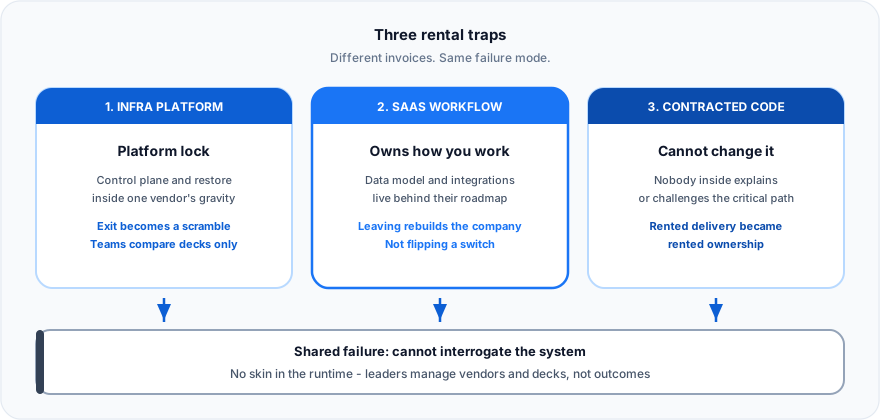
All three traps share one failure: leaders cannot interrogate the system. They manage vendors and status decks instead of understanding the runtime. That felt rational when owning the alternative was too expensive. Skin in the runtime is what makes the next decision honest.
It often is not too expensive anymore. When a small team with end-to-end judgment can own the workflow, renting stops being the automatic answer. Not every SaaS or platform should be replaced—category leaders and regulated systems still earn their keep. What dies is renting by default. (For the narrower case of AI tool vendors, see LLMs Are Becoming a Commodity.)
The Oct–Nov 2025 Cliff
Buy-versus-build before late 2025 and after it are not the same conversation.
Through much of 2025, AI-assisted coding was useful and dangerous in the same breath: great for drafts, demos, and first passes; often “vibe slop” when treated as a delivery system—plausible output that crumbled under real tests, real multi-OS behavior, and day-two operations.
For my own work, October and November 2025 is when that flipped. With real end-to-end judgment in the loop—architecture intent, validation, and ownership of outcomes—the output became better and faster than traditional coding for the classes of work I ship. Not as a slogan. As a before-and-after I lived.
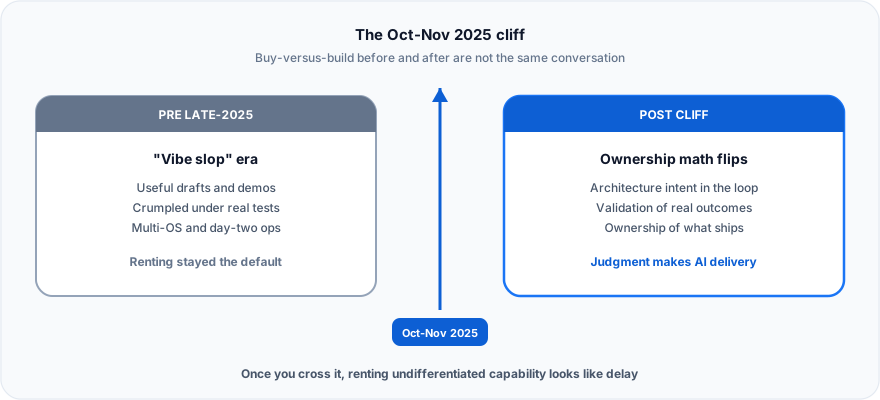
Not every organization hit that cliff on the same calendar. That is not the point. The point is that once a practitioner crosses it, the math of ownership changes. Renting undifferentiated capability stops looking like prudence and starts looking like delay. The debt you postponed because “rebuild is too expensive” may no longer be too expensive—if you still have judgment in the loop. I wrote about the tooling shift around then in The AI Workflow Revolution, and about what serious ownership looks like at product scale in From Concept to Cloud. This article is about what that cliff does to vendor default.
AI Changed the Build Side of Buy-Versus-Build
This is not “anyone can ship a GitHub clone over a weekend.” That is still vibe-slop thinking.
What changed is that small expert teams with end-to-end practice can own categories that used to require a product company or a multi-year SI program: Git hosting, sync tooling, developer utilities, even telephony-shaped systems. I have done that on products I own—QuikGit, QuikPBX, QuikSync, Shanecode Tools—not because side projects are the strategy, but because owning the stack is how you keep the judgment required to advise and lead when the stakes are larger.
AI accelerates the middle. It does not replace the boundaries and invariants that make the middle safe. That is the same discipline behind avoiding cognitive debt: humans keep intent, boundaries, invariants, and outcomes.
Case in One Loop: QuikSync
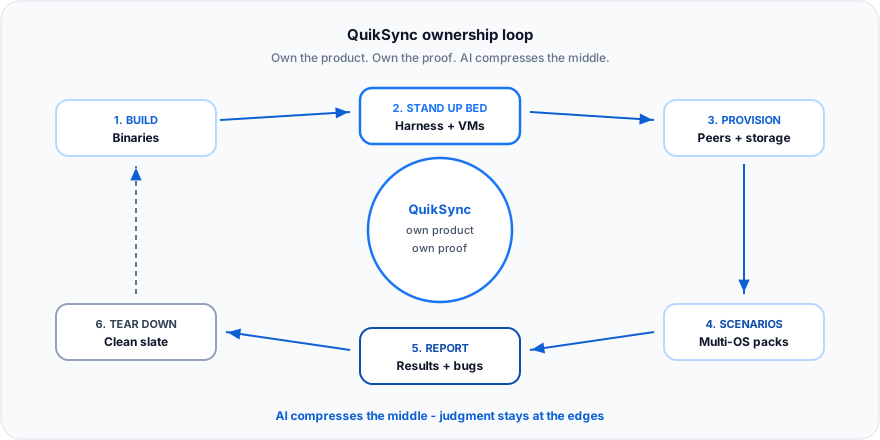
Here is the ownership loop after the cliff, on a product I control.
QuikSync is a sync tool that has to be right across real operating systems—not a demo on one laptop. I needed Linux peers, a Windows Server peer, object storage, NFS, SSH, QUIC, crash-safe resume, and FastCDC sparse deltas. Waiting on a vendor’s test matrix or a contract QA ticket was not an option.
So the validation environment is owned too. On Harvester, a local harness brings up Linux and Windows Server VMs, plus MinIO and NFS, orchestrated from a Mac. One command runs the loop: build the binaries, stand up the bed, provision the peers, run scenario packs, report, tear down. AI helped stand that harness up, chase failures, and push fixes through—inside judgment, not instead of it. The bed caught real bugs unit tests never would, including an NFS protocol mistake that only showed up against a real nfs-kernel-server. A clean run is what I want before I tag a release that ships six OS/arch binaries. No rented QA product in the middle. No SI waiting on a ticket to tell me whether Windows behaved differently than Linux.
That is what owning destiny looks like in practice: own the product, own the proof, use AI to compress the middle. The old default was buy a sync SaaS, outsource the edges, and hope the vendor’s matrix matches your reality. When you rent both the product and the proof, you own a subscription and a story.
A Platform Swap Is Not a Strategy
Tech debt often shows up as a forced platform move. Too many responses are still procurement events dressed up as strategy: pick a new logo, migrate the workloads, declare victory.
In one leadership engagement, an organization had moved hastily onto Proxmox. The logo changed. The hard problems did not. Observability was thin. Control-plane clarity was weak. The platform was not simple enough for teams to operate with confidence. Swapping iron and hoping culture follows is how you get a different rental trap with new jargon.
The work was to install an operating model, not just a new platform: RKE2 and Rancher on Harvester, with a path to any cloud provider when needed, and a redesigned disaster-recovery approach. Portability and restore became first-class. Simplicity for the people who run the system became a requirement, not a nice-to-have.
That is leadership augmentation at program scale. It is the same muscle the lab hones—VMs, Windows-shaped reality, GitOps, observability, blast radius—applied where budgets and blast radius are far larger.
The Ownership Gym
I keep a multi-cluster, GitOps-driven environment—Harvester, RKE2, Fleet, a full observability stack, stateful data services—not as a substitute for leading large programs. It is how decision skills and trench skills stay calibrated. For the full case on why that practice matters for technology leaders, see The Leadership-Grade Homelab.
A leadership-grade lab is not a shopping list. It is a set of constraints:
- VMs you control, including workloads that still look like Windows
- More than one environment, so blast radius is real
- GitOps over click-ops
- Observability you actually use when something breaks
- Stateful data, not only stateless demos
- At least one system that hurts when you are wrong—telephony, sync correctness, restore drills
Windows did not get the memo about “containers only.” Many estates still need Windows Server images, drivers, sysprep-style preparation, and a place to land. Leaders who only practice Linux containers green-light brittle exits. A leadership-grade practice environment still includes VMs you can create and destroy, including boring Windows paths, because boring is where production lives.
Practice is how you know when to still rent. Practice is also what let AI cross from vibe slop to delivery; the tool did not do it by itself. The same judgment is what small end-to-end teams need when they own the whole experience instead of throwing work over walls.
When You Should Still Rent
Ownership without day-two operations is just a different vendor: yourself, unprepared.
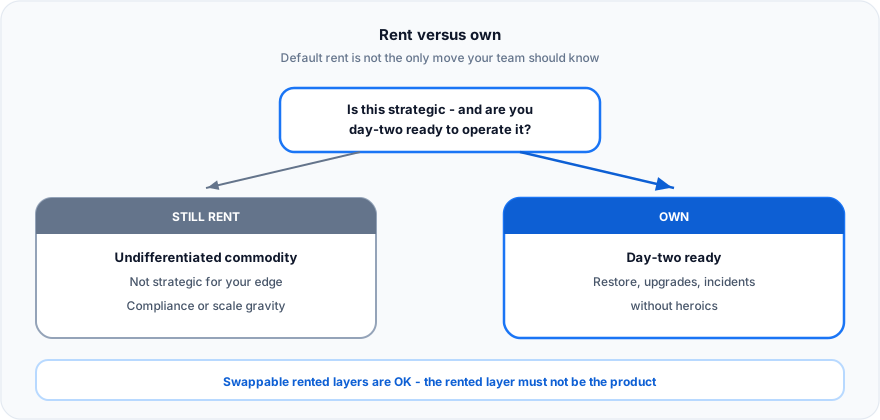
Rent—or keep renting—when the capability is undifferentiated commodity and not strategic, when compliance or scale gravity makes a category platform the rational choice, or when your team cannot operate restore, upgrades, and incidents without heroics.
The sharper question is how the dependency is designed. QuikPBX is a telephony product I own. PSTN transit is still rented—that is rational. The architecture keeps that layer swappable: each tenant brings its own carrier credentials, with no platform-managed fallback, and the portal supports generic third-party trunks alongside the primary path. An adopted edge runs SIP locally, registers LAN extensions, bridges calls, provisions desk phones over the LAN, and runs IVR and queues with local media and on-device TTS. What can work on the LAN keeps working. Video and multiparty stay in the cloud, and PSTN reachability still depends on whichever trunk is up—but the rented layer is not the product. That is the difference between a vendor relationship and a rental trap.
The question is not “build everything.” The question is whether default rent is still the only move your leadership team knows how to make.
Leadership Checklist
Answer these without a slide:
- What do we rent versus own—on purpose, not by habit?
- Who can change the critical code path without opening a vendor ticket?
- Where do legacy and Windows-shaped workloads land when the platform story changes?
- What is the restore story—tested, not theoretical?
- If a SaaS vendor 10x’d price or disappeared, what is our exit in ninety days?
- Has anyone in our leadership actually shipped with AI recently, or are we judging it from the vibe-slop era?
- Could we stand up our own multi-platform validation loop, or are we dependent on a vendor’s matrix forever?
If those answers are fuzzy, you do not have a tooling gap. You have an ownership and judgment gap.
No Better Time
Destiny is owned by people who can still run and ship—and by leaders who keep that judgment current. Waiting for a cleaner quarter is how debt compounds while the window is open.
If you recognize several of these, you may need leadership augmentation whether or not you are already shopping for a “fractional CTO”:
- Tech debt and vendor renewals you keep postponing because “rebuild is too hard”
- AI already inside the company, but buy-versus-build math never updated
- Nobody who can explain restore or portability without a partner on the call
- Trench skills that left with the last people who actually ran the systems
The build-versus-rent chapter of Skin in the Runtime extends this into a ledger you can put in front of a CFO: what ownership costs, what renting quietly costs, and when renting is still the right answer. If there is a vendor decision on your desk that AI has repriced, let’s talk before the renewal.
I take on selective fractional and advisory work where platform, cloud, and AI-stakes decisions need battle-tested judgment—not staff augmentation, not vendor pitches. For how that engagement model works when it is scoped for leverage, see The Fractional CTO Playbook.
Ready to tackle tech debt or a vendor decision you have been postponing? Connect with me on LinkedIn to continue the conversation.
Related insights
The Leadership-Grade Homelab: Why Tech Leaders Need Skin in the Runtime
A production-shaped lab is not a hobby rack—it is deliberate practice that keeps technical judgment calibrated when enterprise stakes are high. Why tech leaders need skin in the runtime.
The Token Bill Is the New Cloud Bill: When Nobody Owns Consumption
AI seats were a project. Agent loops are an operating cost. An executive model for token fat tails, hard-cap rationing, cost per completed owned outcome, and why platform teams—not a monthly invoice—must own the meter.
The Review Bottleneck: When AI Writes Faster Than Humans Can Own the Contract
AI did not remove the human constraint—it moved it from typing to review, and it thinned product ownership of the ask and the outcome. An executive model for review capacity, contract review versus style review, shipping too fast, and when to add gates instead of more senior reviewers.